
+86-0514-87979502
jinyan_yz@163.com
"Hydraulic engineering" doctoral training program
Discipline code: 0815
1. Training objectives
To advocate a training mode dominated by the idea of elite education and aimed at improving innovation ability, cultivate law-abiding, love for the motherland, clear etiquette and integrity, physical and mental health, with a solid and broad basic theory of the discipline and systematic and in-depth specialized knowledge, with an international perspective, capability of independently and creatively engaged in scientific research, teaching and other high-level specialized talents of hydraulic engineering.
2. Research direction
1. "Theory and key technology of high efficiency and safety of large-scale pumping station of cross-basin water transfer project" : Explore the theory and method of optimal design of high-performance pumps and devices, study the automatic optimal design technology of pumps and devices, and analyze the energy performance and cavitation performance of pumps and devices. On the basis of the model experimental verification of the pump device, the principle of the design and selection of the pump device is formed. Research on high precision, low cost pump unit manufacturing technology. To study the comprehensive characteristics of hydraulic and electromechanical systems of large-scale pumping stations, and solve the key technologies of pumping station projects.
2. "Research on hydraulic system reliability theory and optimization of energy saving" : To study the dynamic characteristics, transition process, failure mechanism and reliability, internal flow of the system, energy conversion and transportation of the hydraulic system composed of power engine, transmission device, hydraulic machinery and its conveying equipment, reveal the law of energy loss, establish the theory and method of optimal design and operation of the hydraulic system, and improve the reliability and operation efficiency of the hydraulic system.
3. "Research on water resources development and utilization planning and irrigation and drainage theory" : Based on water resources system analysis theory and regional social and economic planning theory, research on regional water resources development and utilization comprehensive planning, regional water resources system optimization planning and operation management, watershed hydrological simulation and system simulation, hydrological and water resources system risk model and other theories and methods. Research on the precise control and management technology of soil water and fertilizer, the coupling technology of insufficient water and fertilizer in rice, the complete set of ecological interception technology of nitrogen and phosphorus in farmland runoff, and the safe recycling technology of farmland water.
4. "Optimal design of hydraulic structure and research on engineering hydraulics" : research on the most economical optimization model, the safest optimization model and the multi-objective optimization model taking into account both safety and economy of hydraulic buildings under static and dynamic loads. Research on the evaluation and analysis methods of cracks to the structural safety, durability and functional hazards of hydraulic concrete buildings. The unsteady flow algorithm of large river network and the flow movement law of drainage river and forebay of pumping station are studied.
3. Research duration
The research period is generally 4 years, and the maximum research period in school is not more than 8 years (including suspension).
4. Training methods
The training method is oriented by scientific research training, focusing on the organic combination of curriculum learning and scientific research. All doctoral students must be included in the corresponding scientific research team to ensure that each doctoral student can participate in cutting-edge and high-level scientific research work.
Doctoral students who go abroad for exchange and study visits for more than 3 months will receive 2-3 bonus credits, which will be included in the total credits.
5. Curriculum and credit requirements
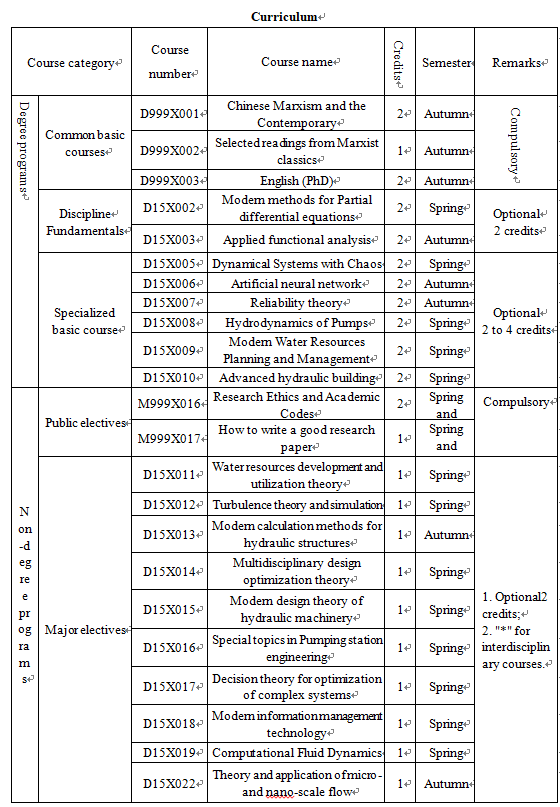
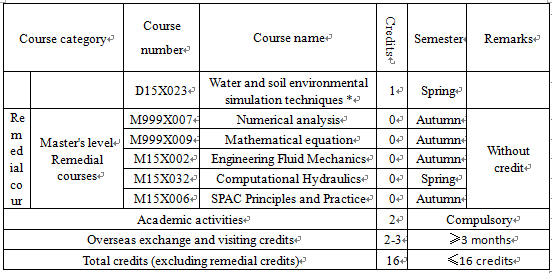
6. Main training processes and assessment requirements
1. Course learning
The common degree courses of doctoral students are organized and assessed by the Graduate School; Other courses are organized and assessed by the college. The assessment method is determined according to the course content, teaching requirements, teaching methods, etc. Emphasis should be placed on the diversity, effectiveness and operability of the assessment forms. Pay attention to the assessment of teaching process, strengthen the close combination of assessment process and teaching process, in order to promote the active study of postgraduates and teachers to improve the quality of teaching.
Assessment is generally divided into two forms: examination and test. The assessment of degree courses takes the form of examination or thesis writing, and the score is assessed according to the percentage system, and the score below 60 is unqualified. Optional courses, practical experiment activities, academic activities and other teaching processes can be carried out by test. The test results are assessed according to excellent, good, pass or fail, and the tutors and relevant teachers can write the comments and the test results to obtain credits.
Doctoral students are required to take the assessment within the prescribed time. If they cannot take the examination or test on time for special reasons or fail to pass the course assessment, they are required to retake the course. Those who fail to pass the re-examination twice will be disqualified from graduation and degree application.
Teachers should log in the graduate information management system at the end of each semester or within 2 weeks of the beginning of the next semester to enter their scores, and send the original materials of all course assessment and the transcript generated by the system to the graduate secretary of the college for storage and reference. The assessment results of public courses shall be sent to the graduate School for storage and reference.
2. Academic activities
Participating in academic activities is an important way for doctoral research training. Supervisors should supervise, inspect, lead and guide doctoral students to participate in expert lectures, academic conferences, postgraduate forums and other academic activities inside and outside the university. Before applying for dissertation defense, doctoral students must participate in more than 15 academic exchange activities, make public academic reports at least 3 times, participate in international academic exchanges at least 2 times, and fill out the Record Form of Academic Activities of Doctoral Students of Yangzhou University, and have the opinions or seals signed by the organizing unit or the lecturers. The instructor shall be responsible for evaluating the effect of the academic report. After the report is finished, it will be sent to the college for review.
3. Experimental practice session
The training of doctoral students should be oriented by scientific research training and pay attention to the organic combination of curriculum learning and scientific research. Doctoral students should be included in the scientific research team of their supervisors, participate in cutting-edge and high-level scientific research work, and cultivate the ability to solve complex practical problems in combination with specific projects and topics. Practice is an important way to improve the quality of doctoral training, and the training of scientific and technological development ability and social practice ability should be strengthened. The forms of practice include research assistant, assistant management, teaching assistant, production practice, social practice, etc. The supervisor evaluates and evaluates the students' practice.
4. Subject comprehensive assessment
Subject comprehensive assessment is a comprehensive assessment of knowledge structure and ability quality organized after the doctoral program and before the thesis proposal. The main contents of the assessment include the course learning, the reading of the literature of the subject and the mastery of the frontier research of the subject. The assessment is organized by the college, and the assessment team should be composed of 3-5 teachers with senior titles in the discipline and related disciplines. The supervisor may participate in the assessment team, but shall not be the leader of the assessment team. The comprehensive assessment of the discipline should be carried out in the third semester after admission, and completed at the latest within 1 month after the beginning of the fourth semester.
The elimination system of discipline comprehensive assessment shall be implemented, and those who fail to pass the assessment will be eliminated.
5. Mid-term assessment
The mid-term assessment of doctoral students should be completed by the end of the fourth semester at the latest. The assessment is organized by the college and includes ideological and political performance, academic performance, and comprehensive scientific research ability. The basic requirements of the mid-term assessment of doctoral students should be: correct political and ideological; Complete all the courses in the training plan and pass the examination; Pass the comprehensive examination of the subject; The total credits of completed courses and degree course credits should meet or exceed the minimum training requirements of the school. The results of the mid-term assessment of doctoral students are divided into four grades, such as A (excellent), B (passed, continue to study for the degree), C (warning, correction), and D (failed, recommended to withdraw from the school). In principle, the doctoral students with the assessment result of B or above can enter the dissertation stage. For doctoral students who have incorrect learning attitude and fail to meet the basic requirements, they should be warned and asked to give corrective measures and report to their colleges. Postgraduates who have submitted corrective action reports can enter the dissertation stage, and the relevant departments are responsible for tracking and checking the implementation of their corrective measures.
The mid-term examination form for doctoral students will be retained by the school after it is summarized.
6. Thesis proposal
Doctoral dissertation proposal work should be carried out after the mid-term examination. The proposal report meeting shall be held openly in the discipline or within the discipline related to the topic of the thesis. The subject expert group shall demonstrate the proposal report, form a concluding written opinion, and fill it into the personal training plan of graduate students. The subject expert group shall be composed of 5-7 people, the proportion of doctoral supervisors shall be no less than 2/3, and the head of the program shall be the leader. For interdisciplinary and cross-disciplinary thesis topics, experts from related disciplines must be hired to participate in the assessment panel.
Doctoral students should make a detailed report on the selected topic at the opening report meeting, and the subject expert group should focus on the innovation and feasibility of the topic chosen by the reporter, and put forward specific opinions and suggestions. For doctoral students who fail to pass the proposal report demonstration, with the approval of the supervisor, they can apply for a new proposal after 3 months. If the proposal is not passed, the subject expert group can put forward the recommendation of elimination.
7. Mid-term examination of the paper
Doctoral students should generally undergo a mid-thesis examination about 1 year after completing their dissertation proposal. Under the guidance of the supervisor, the doctoral student should make a phased summary of the thesis work, describe the completed thesis work content and the phased results, including the completed theoretical research and experimental research and the conclusions obtained, especially the completed part of the phased work that is not consistent with the content of the proposal report. The next step of the work plan and the need to continue to complete the research content of the demonstration, at the same time to introduce the publication of papers and formulate papers related to the research topic publication plan and the content of the paper to be published.
The mid-term examination of the doctoral thesis shall be submitted to the discipline in written form. The supervisor shall give comments on the interim report of the student. The comments shall include the evaluation of the student's existing work, especially the completion of the personal training plan, the student's performance, and the estimation of the follow-up work.
The discipline shall organize a mid-thesis examination group of 3-5 members, which is attended by the supervisor or the head of the guidance group, to conduct a mid-term examination of the doctoral thesis of the relevant degree. The form may be combined with the academic discussion or thematic research report of the graduate student. If the examination fails, the discipline expert group can put forward the recommendation of elimination.
8. Pre-defense of thesis
Two months before the dissertation defense, the discipline shall organize 3-5 experts of the discipline to publicly pre-defend the applicant on the academic level of the dissertation, and determine whether the defense is scheduled, postponed or not. If the applicant has delayed the defense, he/she must make a modification for a period of 3 months, and can apply for the pre-defense again with the approval of the supervisor. If you cannot defend, you must make a 6-month amendment and re-apply for a pre-defense with the consent of your supervisor. If the applicant fails to pass the preliminary examination, the supervisor may make suggestions for elimination. Those who fail to pass the preliminary defense twice will not enter the thesis defense.
The pre-defense shall be recorded by special person, and the original document shall be archived by the college. The college will submit the list of pre-defenders to the Graduate School for review and publish it on the campus network. The publicity period is 3 days. Only those who have no objection can defend their thesis at the expiration of the period.
9. Review papers
The specific requirements for doctoral dissertation evaluation shall be carried out in accordance with the "Double-Blind Evaluation Methods for Graduate Dissertation of Yangzhou University (Revised)" (Yang University Research Institute (2019) No. 52). Only those who pass the evaluation can apply for doctoral dissertation defense. The specific procedures and requirements shall be implemented in accordance with the Working Rules for the Awarding of Doctoral and Master's Degrees of Yangzhou University (Research Institute of Yang University (2014) No. 36).
10. Thesis defense
The dissertation defense committee for academic doctoral students shall be composed of 5-7 experts with profound academic attainments or equivalent professional and technical titles (the number of experts must be singular), of which more than half of the experts are doctoral supervisors and at least 2 outside experts are members.
The chairman of the defense committee shall be a professor or an expert with equivalent professional and technical titles and the qualification of doctoral advisor. The defense committee shall have another secretary who shall have the professional and technical title of lecturer or above or a doctoral degree. The advisor of the degree applicant shall not be a member of the defense committee.
The specific requirements shall be implemented in accordance with the Working Rules for the Awarding of Doctor's and Master's Degrees of Yangzhou University (Yang University Research Institute (2014) No. 36). After passing the defense, the doctoral degree of engineering will be awarded.
7. Requirements for achievements of degree application
The requirements for doctoral degree application achievements shall be implemented in accordance with the Basic Requirements for Scientific Research Achievements of Yangzhou University for Doctoral Degree Application (Trial Implementation) (Yang University Research Institute (2018) No. 32).
Appendix I: Description of core curriculum
1. "Dynamical Systems and Chaos"
It mainly introduces planar linear systems, phase diagrams of planar systems, classification of planar systems, high-dimensional linear algebra, high-dimensional linear systems, nonlinear systems, equilibrium points of nonlinear systems, large range of nonlinear techniques, closed orbits and limit sets, Lorenz systems, discrete dynamical systems, homology phenomena and retreatise on existence and uniqueness, feedback chaos of discrete-time systems, etc. It also introduces the application of these knowledge in biology, circuit theory, mechanics and so on.
2. "Artificial Neural Networks"
This paper mainly introduces the development of neural networks, the structure of neural networks, the basic concepts of shallow learning and deep learning, deep learning and neural networks, neural network training, transfer learning, probability graph model, Bayesian network structure. BP neural network, RBF neural network, GRNN neural network and PNN neural network principle and its application in engineering are introduced.
3. "Reliability Theory"
This paper mainly introduces the development and status of reliability research, basic concepts and problems of reliability, foundation of reliability mathematics, common distribution function of reliability, principle of reliability analysis and reliability calculation, classical model of system reliability, system layer reliability analysis and modeling method, multiple reliability model, failure rate model, failure transfer logic analysis method, Petr of system fault analysis i network model, multi-state system reliability analysis and engineering application of system reliability, etc.
4. “Hydrodynamics of Pumps”
This paper mainly introduces the equation of fluid motion in the impeller of hydraulic machinery, the principle of hydrodynamics of the pump and the analysis of three-dimensional flow characteristics. Cavitation dynamics, hazards and noise, cavitation parameters and cavitation formation in pump, pump cavitation performance; Generation and development of vorticity and its influence on pump operation, calculation method of incompressible turbulence, rotating stall characteristics of pump, vibration analysis of unit induced by unsteady flow in pump, analysis and calculation of unsteady flow in pump system.
5. "Modern Water Resources Planning and Management"
It mainly introduces the basic ideas and methods of modern water resources planning, the basis of water resources system analysis, the theory of water resources management based on ET, the comprehensive assessment method of water resources development and utilization, the principles and methods of water resources management planning and water resources protection planning, etc. In the form of special topics, dynamic simulation analysis of surface groundwater joint operation, multi-objective analysis of macroeconomic water resources system, regional water resources carrying capacity analysis, application of decision support system in water resources planning, digital watershed and water resources planning, etc.
6. "Advanced Hydraulic Building"
This paper mainly introduces some problems that should be paid attention to in the construction of green DAMS in harmony with ecological environment and society. The new trend of DAMS in China, the key technology of dam design and construction, the statistical method of dam deformation and stress, the statistical method of dam seepage monitoring, the construction method of deterministic and mixed models of dam displacement and stress, the stability analysis method of dam abutment and rock slope, etc.
Appendix II: Bibliography and periodical catalogue
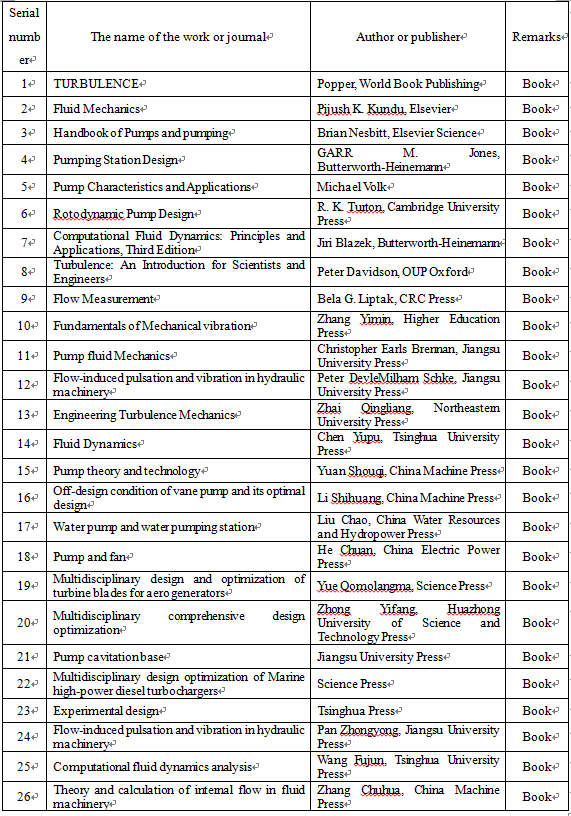
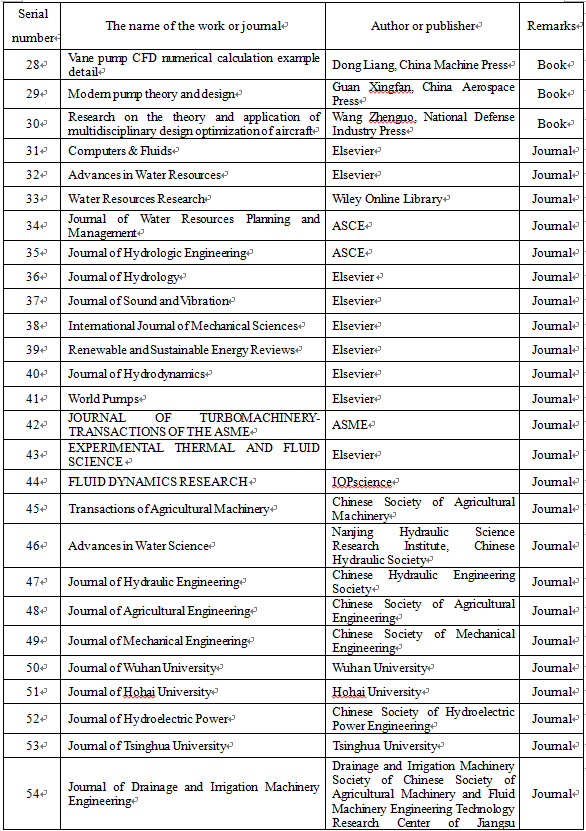

Writing members: (Cheng Li, Lu Weigang, Wang Linsuo, Fang Hongyuan, Sun Linsong, Jin Yan)
CONTACT US
Prof. JIN Yan +86 514 87979520 jinyan_yz@163.comADDRESS
Yangzhou University College of Hydraulic Science and Engineering 131 Jiangyangzhonglu Road, Shuili Building, Yangzhou, China, 225009 苏公网安备 32100302010246号